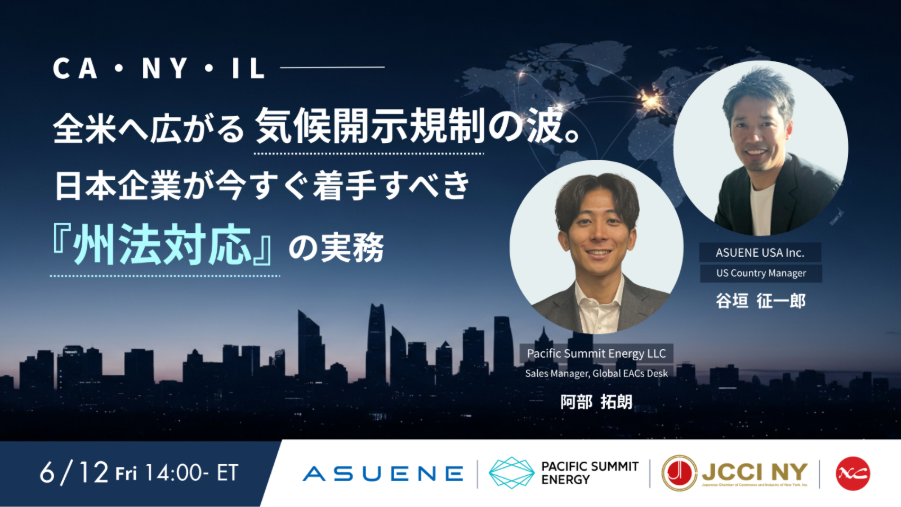
【Webinar】ASUENE USA Inc. / Pacific Summit Energy LLC/ JCCI NY/ Nippon Club Present
Climate Disclosure Regulations Expanding Across the U.S. Practical Steps Japanese Companies Should Take Now
【Date/Time】
Friday, June 12, 2026
2:00 PM-3:00 PM ET
Free Admission
※Please note this seminar will be conducted in Japanese.
In collaboration with ASUENE USA Inc. / Pacific Summit Energy LLC, we will be hosting a seminar in Japanese focused on the expanding wave of climate disclosure regulations across U.S. states and the practical steps Japanese companies should begin taking now. We cordially invite you to take this opportunity to attend.
In the United States, state-level regulations related to climate disclosure and GHG emissions management are expanding, including California’s SB 253/261, as well as regulatory developments in states such as New York and Illinois. For Japanese companies with offices, facilities, factories, or supply chains in the U.S., it is becoming increasingly important to understand these regulatory trends and prepare internal systems for GHG emissions data management, Scope 3 visibility, RECs utilization, and governance.
This seminar will explain how companies can move beyond simple compliance and use climate disclosure readiness as an opportunity to optimize energy costs, rationalize decarbonization investments, and mitigate legal and regulatory risks.
Topics to Cover:
1. Regulatory compliance as an opportunity to accelerate decarbonization and reduce costs
Consistent data strategy: The GHG emissions data collected under climate disclosure regulations, such as CA SB 253/261, should not be viewed merely as a reporting obligation. It is increasingly important to use this data as a management indicator to identify a company’s emissions sources and visualize where inefficiencies exist.
Scope 3 visibility: Understanding emissions across the entire supply chain can serve as a basis for cost optimization, including identifying high-cost business partners and considering a shift to suppliers that use more efficient energy sources.
2. Addressing rising energy costs and strategically using RECs
Role and considerations of RECs: Renewable Energy Certificates, or RECs, allow companies to procure the environmental attributes of renewable energy without physically receiving renewable electricity.
Cost hedging: When direct investment in local renewable energy generation facilities is difficult, RECs can serve as an immediate means of fixing certain decarbonization-related costs.
Strategic procurement: Against regulatory emissions reduction targets, companies need to compare the cost of purchasing RECs with the cost of emissions reductions through internal energy-efficiency investments through a cost-benefit analysis, and build an optimal portfolio.
Awareness of additionality: Looking ahead, regulatory trends are placing greater emphasis not only on purchasing RECs, but also on qualitative disclosure regarding the extent to which renewable energy use contributes to the development of new renewable energy generation capacity.
3. Building governance that connects local operations and headquarters
Regulatory mapping and investment planning: Companies need to closely examine regulatory developments in states such as California, New York, and Illinois, and visualize the urgency of response, including disclosure obligations and potential penalties.
Materials for headquarters alignment: It is important to position local RECs purchases and energy-efficiency investments not simply as environmental costs, but as measures to hedge against medium- to long-term energy price increase risks and to avoid legal and regulatory risks.
4. First steps companies should take now
Conduct an energy audit: Identify energy losses across company facilities and factories.
Develop a RECs procurement strategy: Create a roadmap for how to combine direct investments, such as on-site renewable energy deployment, with RECs purchases in light of the company’s emissions reduction targets.
Establish an internal task force: Build a structure in which sustainability teams work together with general affairs and accounting teams responsible for cost management, so that decarbonization investments can be evaluated in the context of business efficiency and management rationalization.
Seiichiro Tanigaki
ASUENE USA Inc.
US Country Manager
Takuro Abe
Pacific Summit Energy LLC
Sales Manager, Global EACs Desk
【CONTACT】JCCI:info@jcciny.org